Reach
Autonomous outbound in six stages, built so a person is asked wherever the ambiguity is real.
6
pipeline stages, each inspectable
~1/3
of firms produce no email — and are kept, not deleted
The problem
Outbound prospecting is usually six tools in a row: a scraper, a dedup pass, an enrichment credit, a verifier, a writer, a sender. Each exports a CSV the next one imports, and the person in the middle is the integration.
Nothing moves unless somebody pushes it, so the pipeline runs at the speed of one person's attention. And the sending was only ever the automated half — the replies still land on a human who spends the day writing six answers and losing the one that needed a real response.
How it works
You see the searches before anything is bought
Stage one shows the literal queries. Stage two shows what will run and what it is estimated to cost. Nothing is purchased until you confirm, and firms you rejected are never bought again — on any key.
Rejections are remembered
A rejection sticks forever, on every key the firm was found by, so it cannot reappear from another source or another campaign. That is what makes reviewing a list worth doing once rather than every time.
Cheapest first, stopping the moment it is confident
Each business goes down an enrichment waterfall and stops as soon as confidence is reached — per field, not per person. The expensive provider only ever sees what the free ones could not settle.
The merge queue is the product
Everything scoring between 0.55 and 0.85 is too alike to call distinct and not alike enough to merge unasked. A dedup key cannot express that, so it has to guess in both directions silently. This screen is where the guess becomes a question instead — and the answer is remembered.
Every claim traces back to a confirmed fact
Sequences are drafted from the knowledge base and nothing else. A number or customer name that is not in there does not appear in the email — it gets left out rather than guessed at. A fact the system inferred is badged "we guessed — check this" and cannot be swept up by a confirm-all, because that click has to mean something.
Deliverability as settings rather than assurances
Warm-up ramp instead of starting flat. Per-campaign and per-mailbox caps that compose, so neither can be overrun by the other. Send windows in the lead's own time zone. Four ways to stop, one of which cannot be turned off. Auto-pause when bounces pass a threshold, and bounced addresses suppress the domain so the next campaign does not rediscover it.
Held when it should be
A reply arrives with the answer already drafted, grounded in the same knowledge base, then checked against a gate that decides whether it may send without you. Below the confidence floor the draft is held with a reason rather than sent. Any doubt returns a reason rather than null — it errs toward holding.
In the product
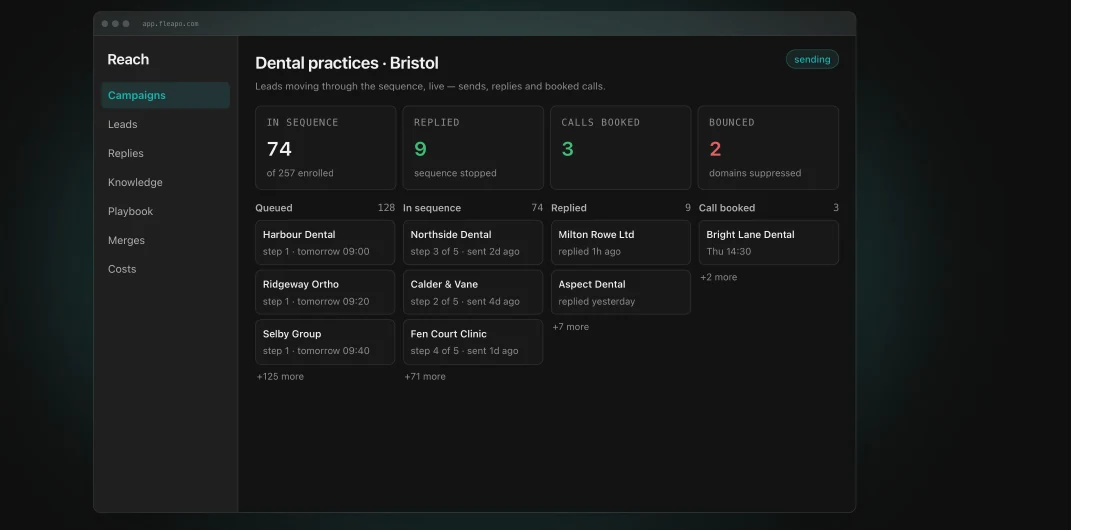
A campaign mid-flight: in sequence, replied, calls booked and bounced, with every lead's current step.
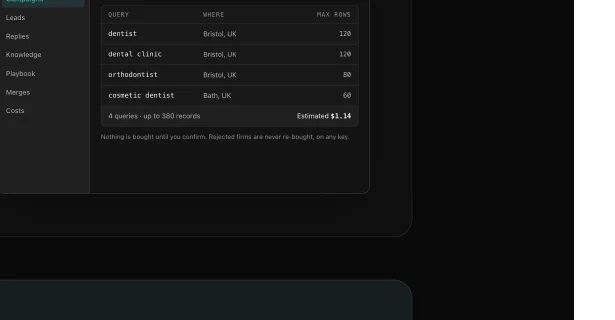
Searches are priced and confirmed before anything is bought. Rejected firms are never re-bought, on any key.
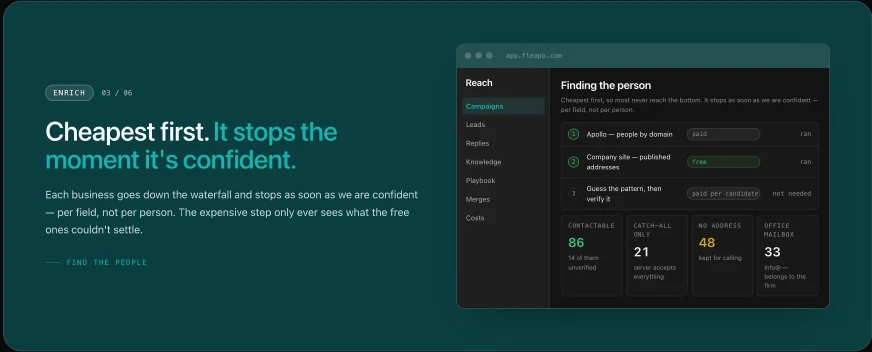
The enrichment waterfall stops per field as soon as it is confident, so the paid step only sees what the free ones could not settle.
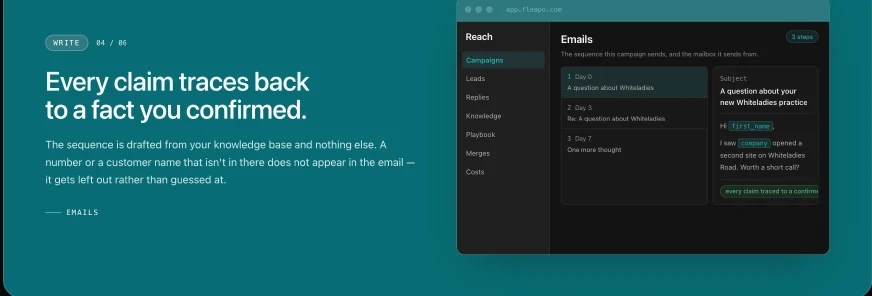
The sequence is drafted from the knowledge base and nothing else — a number that isn't in there does not appear in the email.
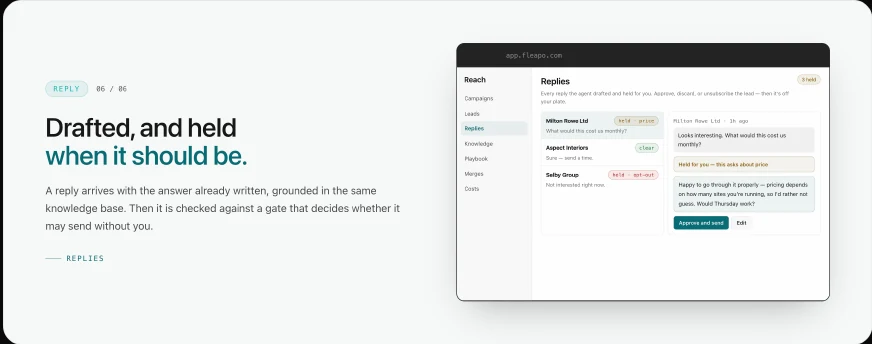
Replies arrive already drafted, then a gate decides whether they may send without a person. Pricing questions are held.
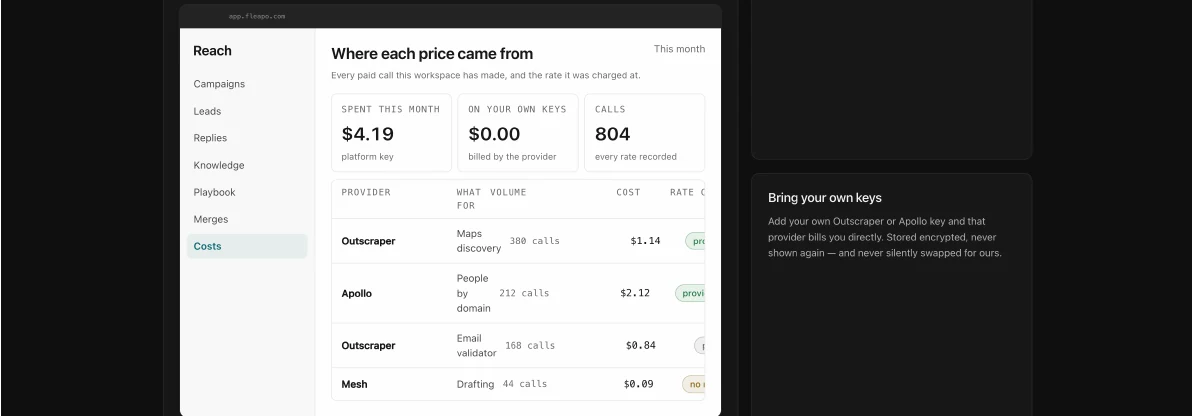
Where each price came from: provider, what it was for, volume, cost and the rate it was charged at.
Decisions worth defending
No embeddings and no vector search, deliberately. A deck of thirty slides holds maybe ten useful facts; they are extracted once, when you add it. A fact that ranked eleventh is not inspectable — a query returning nothing is.
Replies that earned a response feed back to the drafter as examples of form — length, structure, how an opening earns attention — never as a source of facts.
Attribution recorded at send time, so you learn which of your claims actually earn replies rather than which you assume do.
Six documented refusals, each one a function rather than a promise. Won't quote a price by email. Won't invent a proof point. Won't send when it isn't sure. Won't fall back to our key when yours is rejected.
Firms with no discoverable email stay on the list as a call list. "We looked and found nothing" is a different answer from "we never looked", and deleting them silently loses that distinction.
Outcome
The proof section on the landing page is deliberately empty until there are customers to name. Filling it with names that have not agreed and numbers nobody measured would undercut every other claim on the page.
Built with
More work
Start a conversation